From left to right: guide, cook, yak-man, porter. This montly crew worked heroically through heat and hail to provide us with a magical 8-day trek in the Sikkim Himalayas. During our ventures back home we are used to carrying our own loads and eating energy bars and PB&J sandwiches for days on end; the immense care that our guides bequeathed us with on this trip filled us with both humility and graciousness. The staff (plus yaks) carried massive baskets slung from their heads, wore flimsy sandals, and provided us with three delicious, 6-course-meals a day and endless tea. We never lifted a finger, except to make our way up to almost 17,000 feet...
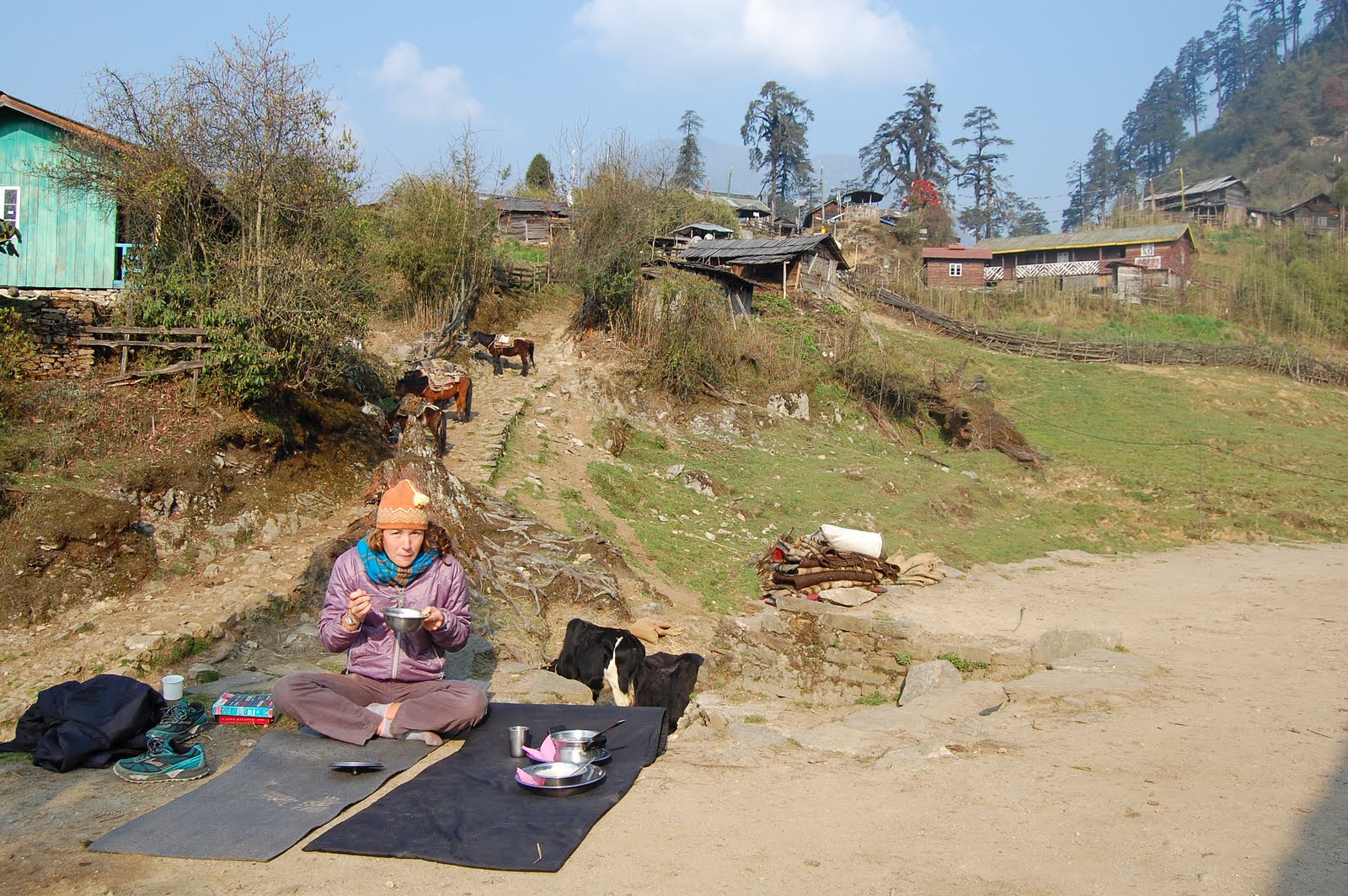 Lauren enjoying a typical breakfast of porridge, pancakes, eggs, cornflakes and tea. On our first day we started from the town of Yuksom (5700 ft), hiking 12 miles up to this idyllic mountain village, Tsohka (10,000 ft). Unlike trekking in other parts of India, this trek was largely wilderness area, protected in the Singalila National park. Besides a few other clusters of huts, this was the only real village we passed through. Sold locally: candy bars, hand-knit yak woolens, and the much appreciated fermented millet beer, served warm.
 A view back down on Tsohka as we head off on our second morning.
 One of the truly special aspects about this trek is that, as it ventures up through over 10,000 feet of elevation gain, it incorporates a wildly diverse range of landscapes. We started our trek in a lush jungle, rising next into a vast and magnificent rhododendron forest, seen in the above and below pictures.
 Countless species of rhododendrons twisted and tangled in thickets, forming mossy archways and coloring the path with blooms.
 As we trekked on, villages disappeared but lonesome trekker-huts remained our sleeping quarters. Though they kept out rain and hail, these weathered, simple stone and wood huts were cold and drafty. This hut was by far the most luxurious, including mattresses and mostly sealed windows. Luckily, we were loaned warm North-Fake sleeping bags, though this was the only decent gear provided.
 Day three took us to Dzongri, an isolated site with a hut and Sikkimese woman who served us warm Thongba, the local millet beer. At just shy of 14,000 feet, the temperatures and lack of oxygen started taking it's toll. As such, we remained in Dzongri for day four, though we took a beautiful hike in the morning up a couple of passes to 14,500 ft (aiding with acclimatization), reaching some of our first stunning views of the tall snowy mountains (above & below).
 This trek took place in Western Sikkim, near the border of Nepal, in the Kanchenjunga Range of the Himalayas. We were surrounded by limitless, immense glacier filled mountains, rising well over 20,000 feet.
 These thankless beasts trudged over incredibly trying terrain loaded with a couple hundred pounds of our comforts. Not traditional Yaks, they are known as Dzo, a male hybrid of a Yak and domestic cow. Yak-men are equally as colorful- singing, yelping, whistling, and kicking the beasts around.
 After hiking up several steep passes and through vast plateaus, we dropped down into an incredibly scenic riverbed. The river, part moraine, was chocked with large polished boulders and a milky-white, flowing river. This river led us up to our 4th and 5th nights at Tansing.
 Tansing provided a crumbling stone hut amidst an absolutely stunning valley floor, surrounded by massive mountains and hanging glaciers. Upon arriving here we had a couple hours of wonderful sun, enjoying a game of cricket with our staff, until the Himalayas gave us a glimpse of it's power to change weather in the blink of an eye. We huddled in our sleeping bags for a few hours while raging winds, hail, and snow blanketed the valley and surrounding peaks. The storm cleared as quickly as it came (above picture) and brought gorgeous weather for our big push of the trek up to Goechela Pass, starting at 2 AM the next morning.
 We walked for a few hours in the snow and dark, climbing steadily up the valley, arriving at our first viewpoint of Goechela Pass for a mind-blowing sunrise (16,000 ft). It was at this point that we were truly immersed in the Kanchenjunga Range, feeling tiny among these giants. It was also incredibly cold and the path was becoming a bit slippery; it took some coaxing to get our guide to continue for the next couple hours.
  We continued through the desert-like valley in a cirque of tall rocky peaks and jagged glaciers.
After breathlessly climbing up snow-covered scree and boulders we reached our final two view points (17,000 feet) exposing Kanchenjunga (the third highest mountain in the world) in all it's glory (seen above, behind Jay). The view of the surrounding Indian and Nepali Himalayan peaks was magical.
 The snow melted and the skies stayed clear for a marvelous, long hike back to Tansing. We spent the next three days hiking back to Yuksom, back through the valley and steep ridges, thick rhododendron forests, small villages, and wet jungles. Our hiking was done in the short and early sun, as we were plundered by incredibly powerful storms in the afternoons and evenings. Beer and pizza upon arrival back in Yuksom.